
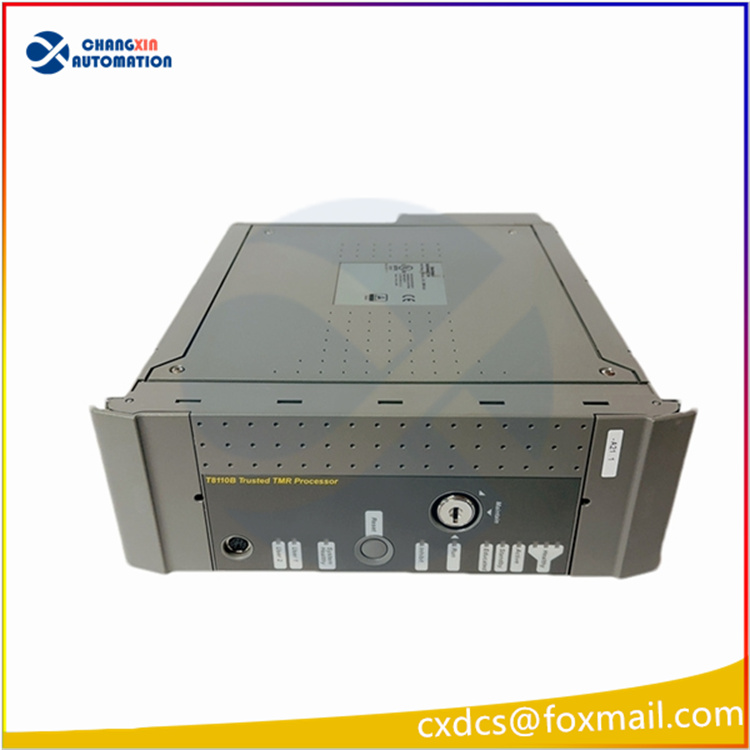

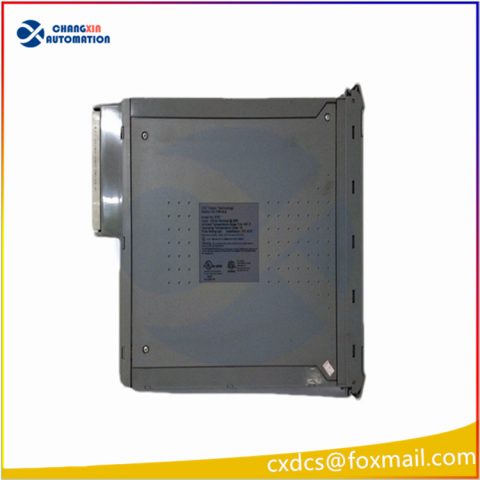
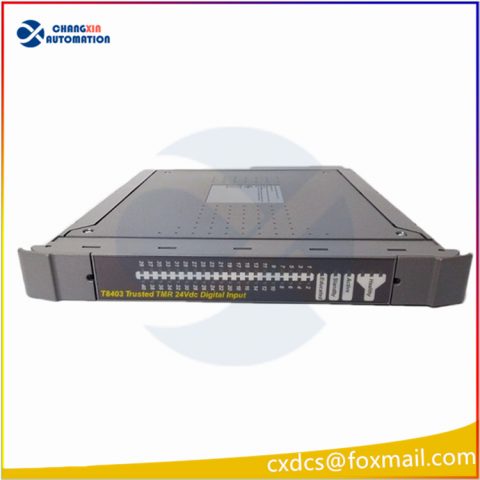
The ICS TRIPLEX T8110B TMR Processor Control System Module is a high-performance triple-module redundant (TMR) processor module specifically designed for critical industrial control systems. Its core functions, technical features, and application scenarios are as follows:
I. Core Functions
Triple Redundancy Fault Tolerance (TMR)
Three independent processors execute the same program simultaneously, ensuring output consistency through the “lockstep synchronization” mechanism. If any processor fails, the remaining two can automatically take over, achieving a “3-2-0” fault-tolerant operation, guaranteeing continuous system operation.
Hardware-level Fault Tolerance (HIFT) architecture and dedicated testing mechanism enable millisecond-level fault detection and response, avoiding false alarms.
Highly Reliable Digital Signal Processing
Supports multi-channel digital input/output, can connect switches, sensors, etc., and can collect and transmit signals in real time (such as emergency stop buttons, fire alarm signals).
Input signal response time reaches millisecond level, ensuring rapid response to external changes.
Safety and Fault Management
Built-in timestamp fault recording function, allowing for traceability of fault history.
Supports hot-swappable replacement, no need to reload programs, reducing downtime.
Provides active/standby processor fault contacts, facilitating system monitoring and maintenance.
Technical Characteristics
Communication Interface
Equipped with RS485/RS422 interfaces (supporting 2/4-wire configurations), compatible with industrial protocols such as Modbus, enabling seamless integration with upper computers or other devices.
Supports IRIG-B time synchronization signals (B002/122 format), ensuring precise synchronization of system time.
Certification and Standards
Passed TÜV certification, compliant with IEC 61508 SIL 3 safety integrity level, suitable for high-risk industrial scenarios (such as chemical, power, nuclear energy).
Modular Design
Plug-and-play structure, facilitating installation, replacement and expansion, reducing maintenance costs.
Integrated status indicator lights and RS232 diagnostic ports on the front panel, supporting real-time monitoring and configuration.
Programming Support
Compatible with IEC 61131-3 standard programming languages (such as ladder diagrams, function block diagrams), flexibly adapting to different control requirements.
III. Application Scenarios Industrial Automation
Monitor the operating status of equipment (such as pressure vessels and pipeline systems), collect real-time parameters like temperature and pressure, and achieve process control and safety interlocks.
For example: In chemical production, the TMR architecture ensures the continuity of temperature control for reaction vessels, preventing accidents due to single-point failures.
Safety System
Integrated into safety devices such as emergency stop and fire alarm to ensure reliable transmission and response of critical signals.
For example: In power substations, the T8110B monitors the status of circuit breakers to achieve rapid fault isolation.
Environmental Monitoring and Energy Management
Connect smoke detectors, temperature and humidity sensors, etc., to achieve real-time monitoring and early warning of environmental parameters.
For example: In data centers, the TMR processor ensures the stable operation of the air conditioning system, avoiding overheating that could damage equipment.
Building Automation
Control lighting, air conditioning and other systems, triggering intelligent operations based on switch status, and improving energy efficiency and management efficiency.
V. Summary of Advantages
High Availability: TMR architecture and hot-swappable design achieve 99.999% availability, meeting critical task requirements.
Flexible Expansion: Supports multi-protocol communication and modular expansion, adapting to complex industrial environments.
Safety Compliance: Complies with SIL 3 standards, passes TÜV certification, reducing system risks.
Maintenance Convenience: Pre-installed diagnostic ports and fault recording functions simplify fault diagnosis and system upgrades.
Applicable Scenarios: Chemical, power, nuclear energy, rail transit and other industrial fields with extremely high requirements for system reliability.

There are no reviews yet.