

Core Function: Protocol Conversion and Cross-Network Communication
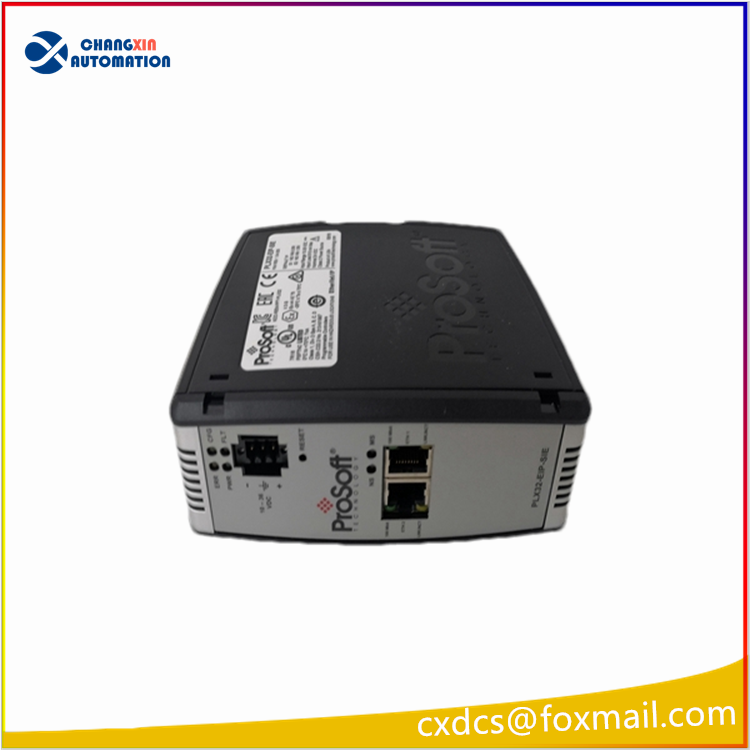
The PLX32-EIP-SIE is an Ethernet communication gateway specifically designed by ProSoft Technology for industrial automation. Its core function is to achieve bidirectional high-speed data transmission between Rockwell Automation’s EtherNet/IP protocol and Siemens’ industrial Ethernet protocols (such as S7 TCP/IP). The design goal is to address the protocol compatibility issue between different manufacturers’ devices, enabling devices that were previously unable to communicate directly (such as Rockwell PACs and Siemens S7 PLCs) to be seamlessly integrated.
Technical features: High performance and high reliability
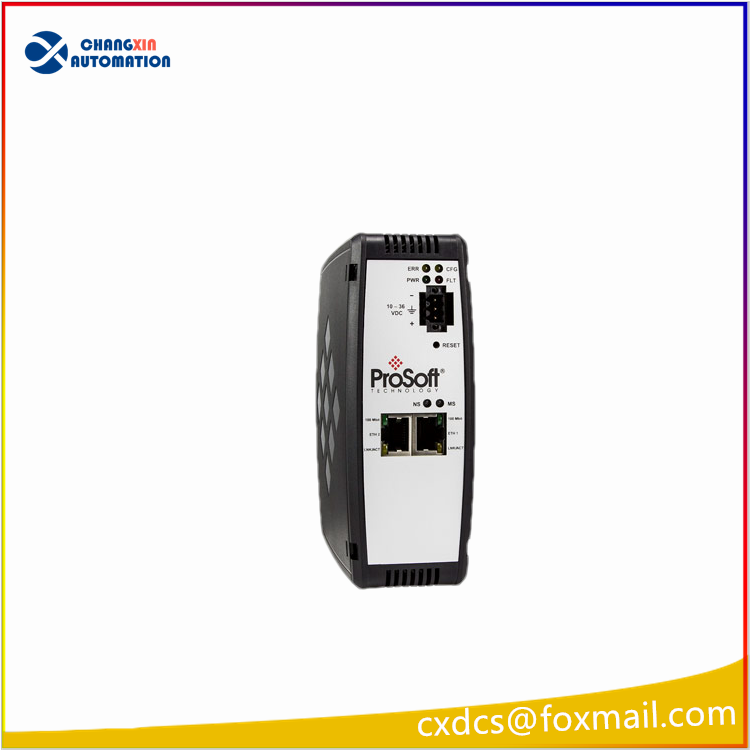
Dual Ethernet port design
The module is equipped with 2 independent RJ45 Ethernet ports, supporting a transmission rate of 10/100 Mbps.
Port 1: Supports the EtherNet/IP protocol (Client/Server mode), and can be configured as 5 Server connections, 2 Connected Client connections, and 1 Unconnected Client connection.
Port 2: Supports the Siemens Industrial Ethernet protocol (such as S7-1200/1500 series), enabling direct communication with Siemens PLCs.
Advantages: Allows EtherNet/IP and Siemens protocols to run on different subnets separately, avoiding IP address conflicts and enhancing network security.
High-speed data transmission and low latency
Maximum EtherNet/IP Class 1 I/O connection number: 2, each connection supports 248 bytes of input/248 bytes of output, meeting the requirements of real-time control.
Minimum RPI (Requested Packet Interval) time: 5 ms/connection, ensuring the data update frequency.
Data exchange capacity: Supports up to 4000 16-bit registers for data exchange, suitable for complex system integration.
Industrial-grade hardware design
Supply voltage: 24 VDC nominal (allowable range 10-36 VDC), adaptable to power fluctuations in industrial sites.
Operating temperature range: -25°C to +70°C, storage temperature range: -40°C to +80°C, adaptable to extreme environments.
Protection level: IP20 (standard rack installation), optional IP65 protection level modules for harsh environments.
Typical application scenarios
Factory automation
Scenario: Production lines in the same factory that simultaneously use Rockwell and Siemens control systems (such as the coordination of robot control and conveying systems in automotive manufacturing).
Value: Eliminate protocol barriers, achieve seamless communication between devices, and reduce system integration costs.
Process automation
Scenario: Integrating Rockwell controllers with Siemens DCS systems in process industries (such as reaction vessel control in the chemical and pharmaceutical industries).
Value: Unify data formats, improve production monitoring and scheduling efficiency.
Infrastructure and energy management
Scenario: Integrating multiple brand controllers in systems such as water treatment and power distribution (such as Rockwell PLC controlling pumping stations, Siemens PLC monitoring the power grid).
Value: Achieve cross-system data sharing, optimize resource scheduling and fault diagnosis.

There are no reviews yet.